Detailed breakdown of core ISO PDF standards
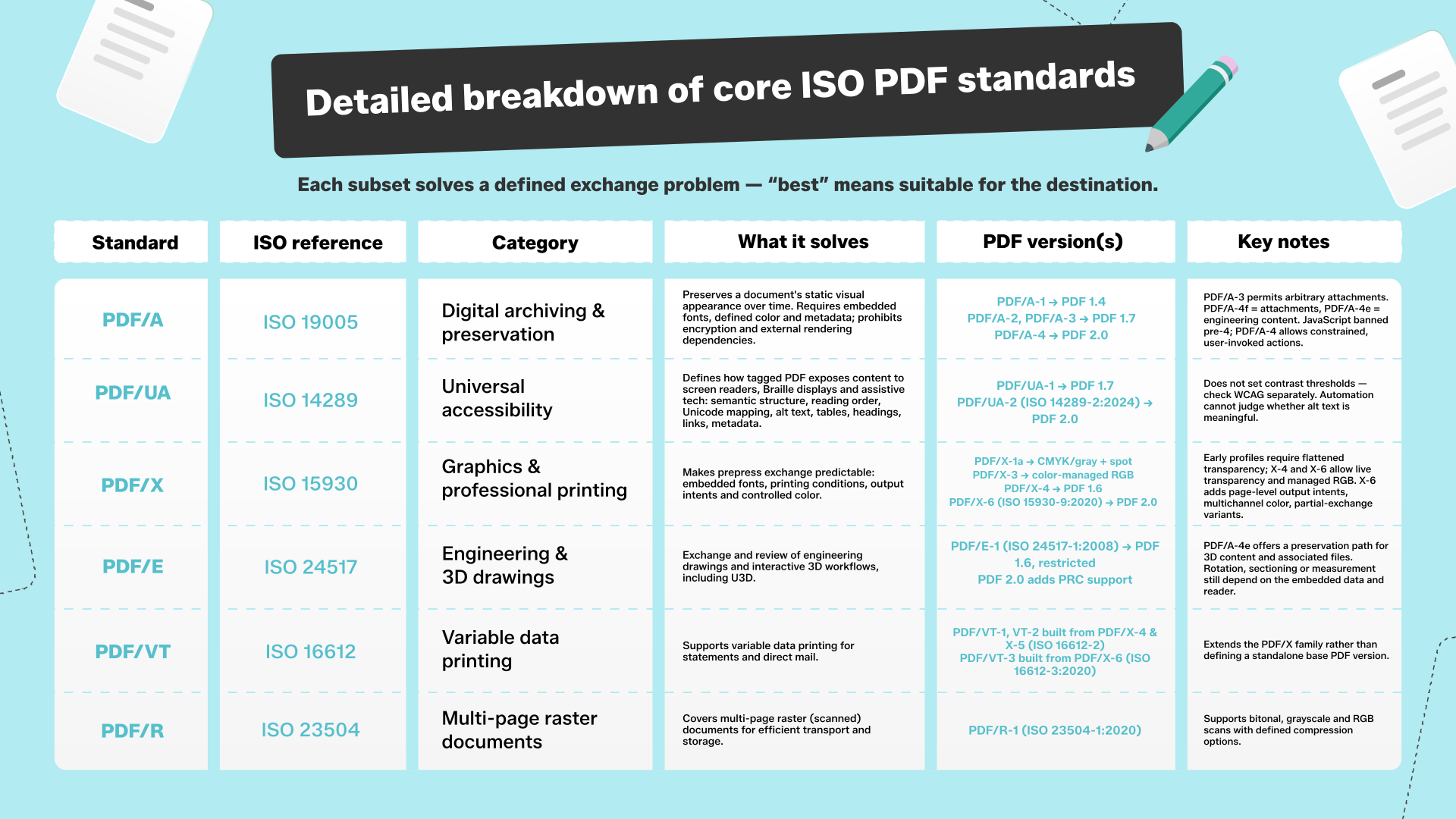
Each subset solves a defined exchange problem; “best” means suitable for the destination.
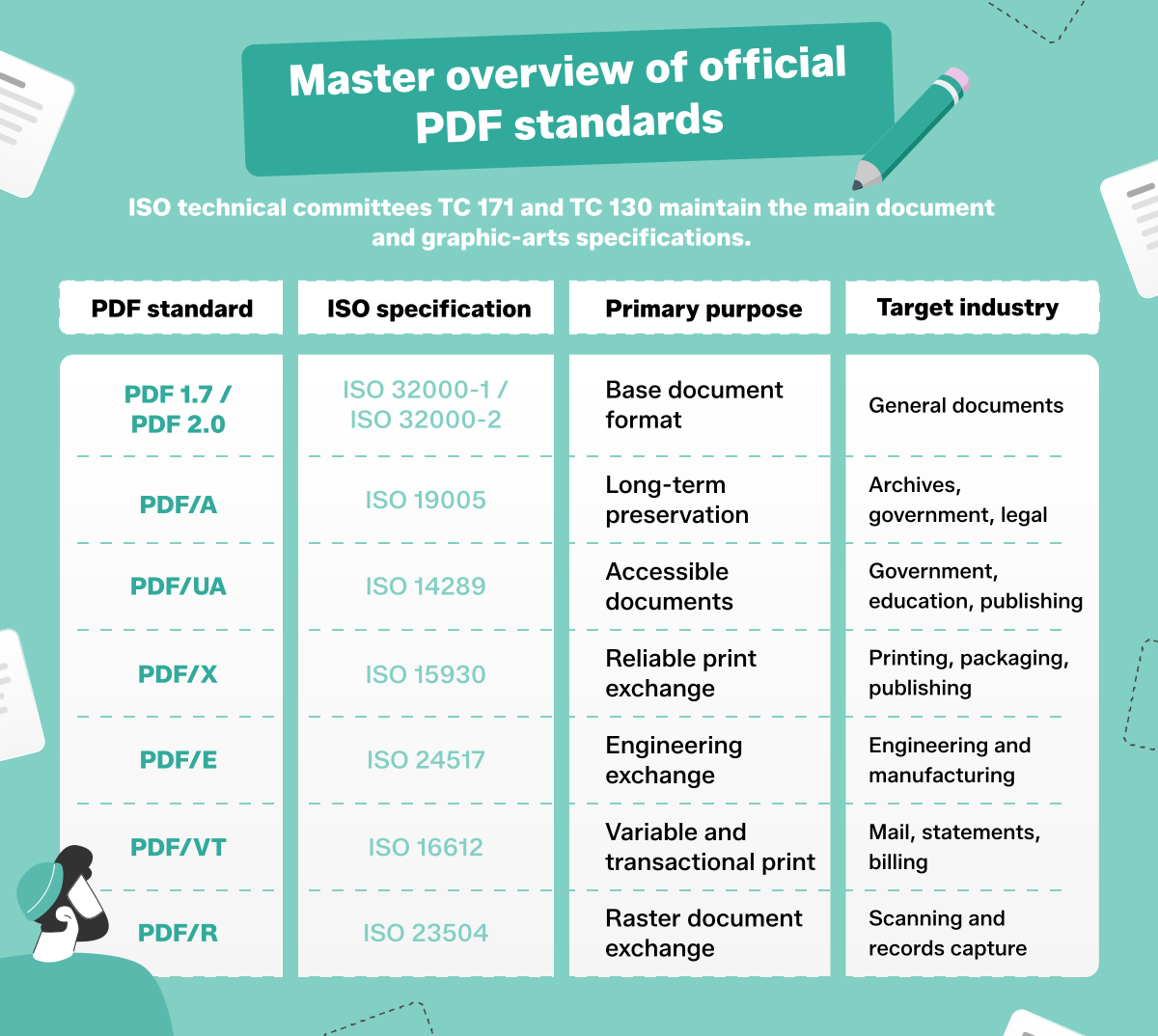
PDF/A (ISO 19005) – Digital archiving & preservation
PDF/A preserves a document’s static visual representation over time. It requires embedded fonts, defined color, and metadata while prohibiting encryption and external rendering dependencies; it does not guarantee identical rendering forever. PDF/A-1 uses PDF 1.4, while PDF/A-2 and PDF/A-3 use PDF 1.7. PDF/A-3 permits arbitrary attachments. PDF/A-4 uses PDF 2.0, with PDF/A-4f for attachments and PDF/A-4e for engineering content. Earlier parts ban JavaScript; PDF/A-4 permits constrained, user-invoked actions.
PDF/UA (ISO 14289) – Universal accessibility
PDF/UA defines how tagged PDF exposes content to screen readers, Braille displays, and other assistive technologies. It covers semantic structure, reading order, Unicode mappings, alternative descriptions, tables, headings, links, and metadata. PDF/UA-1 applies to PDF 1.7; ISO 14289-2:2024, or PDF/UA-2, applies to PDF 2.0. PDF/UA does not set contrast thresholds, so evaluate applicable WCAG requirements too. Automation cannot judge whether alt text is meaningful.
PDF/X (ISO 15930) – Graphics & professional printing
PDF/X makes prepress exchange predictable through embedded fonts, printing conditions, output intents, and controlled color. Rules vary: PDF/X-1a limits process color to CMYK and gray plus spots, while PDF/X-3 permits color-managed RGB. Early profiles require flattened transparency; PDF/X-4 and PDF/X-6 allow live transparency and managed RGB. PDF/X-4 uses PDF 1.6. PDF/X-6, ISO 15930-9:2020, uses PDF 2.0 and adds page-level output intents, multichannel color support, and partial-exchange variants.
PDF/E (ISO 24517) – Engineering & 3D drawings
PDF/E-1, ISO 24517-1:2008, restricts PDF 1.6 for exchanging and reviewing engineering documents. It suits drawings and interactive 3D workflows, including U3D. PDF 2.0 adds PRC support; PDF/A-4e offers a preservation path for 3D content and associated files. Rotation, sectioning, or measurement still depends on the embedded data and reader.
PDF/VT supports variable data printing for statements and direct mail. ISO 16612-2 defines PDF/VT-1 and PDF/VT-2 from PDF/X-4 and PDF/X-5; ISO 16612-3:2020 defines PDF/VT-3 from PDF/X-6. PDF/R-1, ISO 23504-1:2020, covers multi-page raster documents. It supports bitonal, grayscale, and RGB scans with defined compression options for efficient transport and storage.
Industry profiles and extension standards
Not every recognized profile is an ISO subset. Sector guidance may instead define how existing PDF features work together.
PAdES (ETSI EN 319 142) – Advanced electronic signatures
PAdES, or PDF Advanced Electronic Signatures, is an ETSI family for interoperable signatures used in European transactions, including eIDAS contexts. EN 319 142-1 defines baseline levels. B-T adds a trusted timestamp; B-LT embeds validation material; B-LTA adds document timestamps for longer-term integrity. Legal effect still depends on identity assurance, certificate type, process, and applicable law.
PDF/H is not an ISO conformance standard. AIIM/ASTM BP-01-2008 is voluntary guidance for capturing, exchanging, preserving, and protecting healthcare information in PDF. It supports clinical forms and XML-based health data; implementations may carry DICOM material. The guide does not prove privacy-law compliance. Organizations must separately apply access controls, security, retention, accessibility, and validation rules.
PDF validation mechanics & why compliance fails
A metadata claim is only a declaration. Validation tests the document; human review covers requirements software cannot judge.
How PDF validation engines work
Validation engines parse the cross-reference structure and object tree, then apply rules derived from each specification’s “shall” statements. They inspect fonts, glyph mappings, color spaces, output intents, actions, files, signatures, tags, and XMP metadata. veraPDF provides machine-verifiable PDF/A and PDF/UA profiles; preflight engines cover print workflows. PDF/UA still needs human review for reading order and alt text quality.
Top 4 technical reasons PDF files fail compliance
- Fonts are incomplete. Unembedded fonts or missing glyph data undermine preservation.
- Color is uncharacterized. Device-dependent values or a missing output intent can break PDF/X.
- Structure is inaccessible. Bad tags, reading order, tables, or alternatives fail PDF/UA.
- Active content is prohibited. JavaScript, disallowed actions, multimedia, or XFA can invalidate archival profiles.
Conclusion & standard selection decision tree
- Printing a magazine, package, or brochure: choose the printer’s required PDF/X level.
- Storing contracts or records: choose the archive’s accepted PDF/A profile.
- Publishing public documents: use PDF/UA with the applicable accessibility standard.
- Sharing CAD or 3D documentation: consider PDF/E-1, or PDF/A-4e for preservation.
The right ISO standard improves integrity, accessibility, and compliance without guaranteeing them alone. Confirm the required profile, export deliberately, validate the file, and review what needs human judgment.

 Published Sep 16, 2026
  8 min
8 min  75 views